
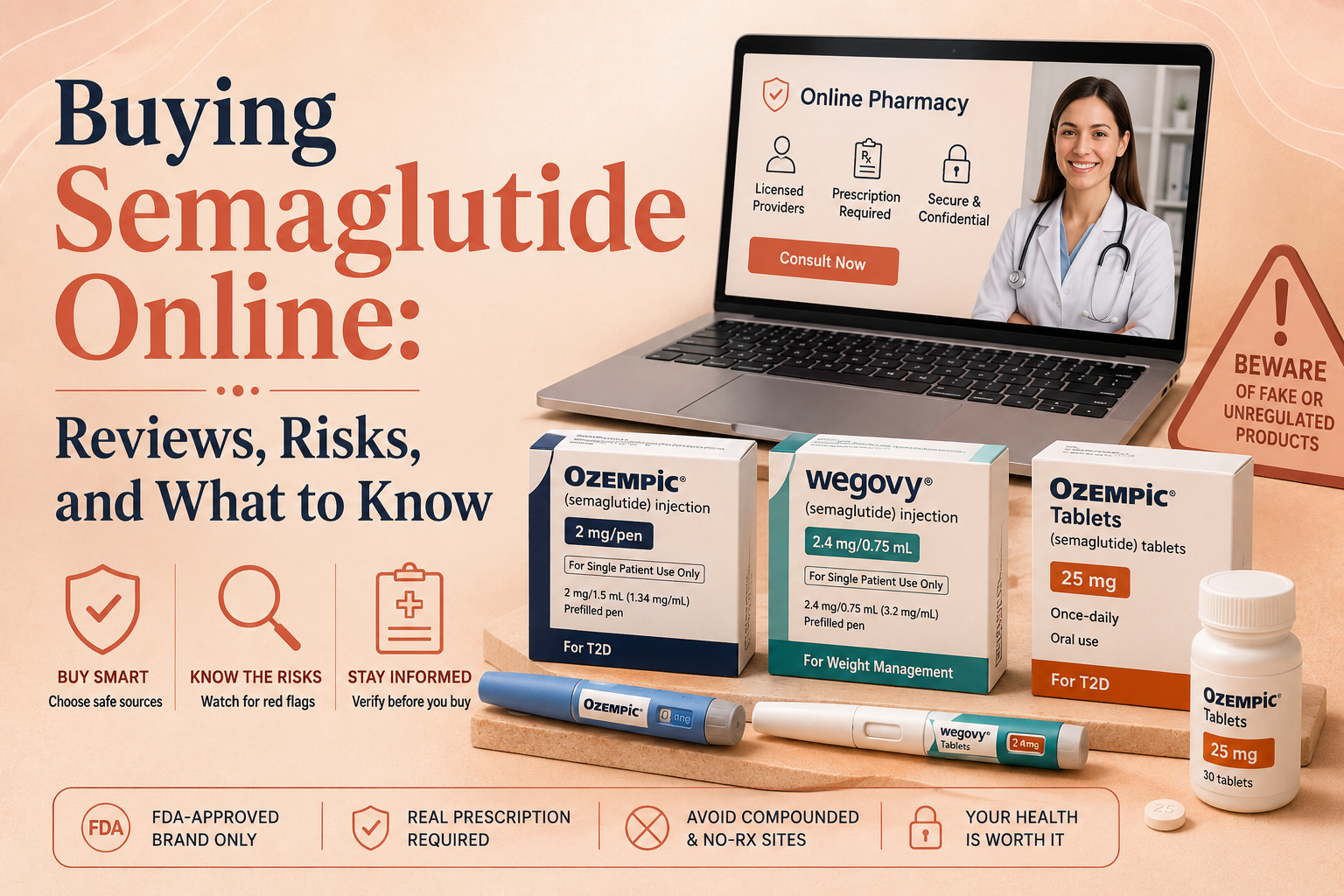
Buying Semaglutide Online: Reviews, Risks, and What to Know
A quick search for semaglutide online serves up a flood of tempting offers—telehealth consultations, discounted vials, and even sites that skip the prescription entirely. But the gulf between the polished marketing and what actually lands at your door can put you in a hospital; your supply chain determines whether you’re getting a rigorously tested medication or an untested gamble.
Disclaimer: This article is for general education only and does not replace medical advice from a licensed healthcare professional.
Search “semaglutide online” and the ads stack up fast. One click lands on a polished telehealth page promising a prescription in minutes. Another takes you to a pharmacy dangling a discount vial. A third opens a site that won’t ask for a prescription at all. The distance between what those pages promise and what you actually get can put you in a hospital. Unlike many wellness peptides that coast on animal studies, semaglutide has enormous human trial data behind it — but only when you get the real thing. Your supply chain picks whether you’re taking a proven medication or rolling the dice.
The Direct Answer
Only FDA‑approved, brand‑name semaglutide — dispensed through a real prescription from a licensed provider — is backed by clinical trials and manufactured under strict federal quality controls. Compounded versions from telehealth clinics sit in a legally contested gray zone with unknown safety. Any site selling semaglutide without a prescription is illegal and dangerous. Learn the three‑tier map so you can spot the difference before you order.
What Semaglutide Is — and Why the Brand Names Matter
Semaglutide mimics a gut hormone called GLP‑1 that your body releases after you eat. It triggers insulin release when blood sugar is high, slows stomach emptying so you feel full longer, and talks to brain receptors that dial down hunger and cravings. That’s the mechanism behind its power for both diabetes and weight management.
But semaglutide isn’t one product. It arrives under three distinct FDA‑approved brands from Novo Nordisk, and they aren’t interchangeable:
- 1Ozempic (injection) — FDA‑approved for type 2 diabetes and for reducing the risk of major cardiovascular events and worsening kidney disease in that population. Maximum dose: 2.0 mg.
- 2Wegovy (injection and tablet) — FDA‑approved for chronic weight management in adults and adolescents with obesity or an overweight‑related condition. Maximum dose: 2.4 mg injection, 25 mg tablet. The oral tablet was approved in December 2025.
- 3Ozempic tablets (oral for T2D) — formerly called Rybelsus, rebranded in January 2026. They also carry a cardiovascular risk‑reduction indication.
Calling everything “Ozempic” erases differences in dosing, approved uses, and insurance coverage. Wegovy is the weight‑loss brand; Ozempic is not FDA‑approved for weight loss alone.
The Three Ways You Can Get Semaglutide Online
1. The Legitimate Prescription Route (Brand‑Name, FDA‑Approved)
Several telehealth services connect you with a licensed provider. If the provider determines you’re a candidate, you get a prescription for brand‑name Wegovy, Ozempic, or Ozempic tablets. With insurance, your out‑of‑pocket cost can drop sharply, though many plans still exclude obesity medications. Without insurance:
- 1Wegovy injection list price: about ,349 per month (down from ,833 in 2025).
- 2NovoCare Pharmacy direct‑ship program (Novo Nordisk’s own pharmacy): $349 per month for maintenance doses, with a 99 introductory offer for starter doses through December 2026 — the lowest brand‑name price available.
- 3Future price drop: Novo Nordisk announced list prices for Wegovy, Ozempic, and Rybelsus will fall to $675 effective January 1, 2027.
This route guarantees you’re getting the exact molecule studied in the STEP trials, manufactured under Good Manufacturing Practices, and delivered in a pre‑filled pen with accurate dosing. Nothing else on the market can make that claim.
2. Compounded Semaglutide Through Telehealth (A Rapidly Shrinking Gray Zone)
Compounded semaglutide is not FDA‑approved. After the nationwide shortage ended in February 2025 (with grace periods ending by May 2025), making an unauthorized copy of the approved drug became impermissible. Some pharmacies still operate under narrow exceptions while the FDA pushes to permanently exclude semaglutide from large‑scale compounding. The public comment period on that proposed rule closes July 30, 2026 — so the legal ground is still shifting.
The salt‑form red flag. Many compounders use semaglutide sodium or semaglutide acetate — salt forms that are chemically different from the FDA‑approved base. The FDA has stated it “does not have information on whether these salts have the same chemical and pharmacologic properties.” No clinical trial has ever tested them for safety or efficacy.
If you still consider this route, verify three things before you proceed:
- 1The pharmacy holds a current state license and operates under FDA‑regulated compounding standards (503A for traditional pharmacies, 503B for outsourcing facilities with stricter sterility requirements).
- 2The pharmacy can supply a certificate of analysis — an independent lab report confirming purity and potency — from an accredited facility.
- 3A real telehealth provider, not a questionnaire bot, reviewed your medical history and wrote a prescription.
The programs you’ll see in search results include Hims & Hers, Ro Body, Henry Meds, Mochi Health, and FormBlends. Most sell compounded semaglutide for 49 – $299 per month, with membership fees often added on top. Calibrate prescribes only brand‑name Wegovy. These are legitimate businesses, but the product they route to you is not the FDA‑approved version — a distinction many marketing pages glide past.
3. “Research Chemicals” and No‑Prescription Sites (Illegal)
Search “cheapest semaglutide online” and you’ll land on sites selling vials of freeze‑dried powder that you must mix yourself. They’re labeled “for research purposes only” or “not for human consumption.” That is illegal. The FBI has warned that counterfeit semaglutide products have been found to contain mixtures of unknown drugs, high levels of impurities, and sometimes no semaglutide at all. In the legitimate U.S. supply chain, counterfeit Ozempic pens were seized by the FDA in April and December 2025 — both lots had contents that could not be conclusively identified.
A 2024 study of semaglutide bought from unregulated online sellers found that only about 30% of samples met quality standards. In one analysis, semaglutide from illegal online pharmacies scored 8 – 9 out of 22 on a visual‑inspection checklist, while the genuine brand‑name product scored a perfect 22. Red flags: payment through Venmo, CashApp, or cryptocurrency; no prescription required; a promise of a “semaglutide online prescription” without an actual consultation.
What the Clinical Trials Actually Show — and What Forums Do Not
Scroll through before‑and‑after photos and every form of semaglutide looks like a miracle. Anecdotes are not evidence. Celebrity weight loss proves nothing — you can’t see the diet, exercise, or medical supervision behind the image.
The human trial data for the genuine molecule is robust. Across six randomized controlled trials with nearly 4,000 participants, once‑weekly semaglutide 2.4 mg produced an 11.8% greater reduction in body weight versus placebo — an absolute loss of 12.2 kg (about 27 lbs). In the STEP program, people without type 2 diabetes lost a mean of 14.9–17.4% of their body weight over 68 weeks to two years. The cardiovascular and kidney risk reduction data are so solid they earned their own FDA‑approved indications.
That evidence is for the branded product, titrated under medical supervision. When you step away from that, everything changes. FDA adverse‑event reports tied to compounded semaglutide already number in the hundreds, including dosing errors, severe gastrointestinal effects, fainting, and hospitalizations — often because a multi‑dose vial and an insulin syringe replaced the foolproof pre‑filled pen.
Red Flags Before You Order
If any of these apply, walk away.
- 1No real consultation. If a licensed clinician doesn’t review your medical history before prescribing, it’s illegal. Every legitimate telehealth service includes that step.
- 2Vial you must reconstitute. Any product that requires you to mix a powder yourself is an unregulated research chemical, not a legitimate compounding pharmacy. Walk away.
- 3Price too low. Dirt‑cheap offers ($50 – $60) almost certainly mean substandard or counterfeit product.
- 4Untraceable payment. Venmo, CashApp, or crypto bypass fraud protections; real pharmacies take credit cards.
- 5Can’t verify the pharmacy license or get a certificate of analysis. If the provider won’t share that information, stop.
When you talk to a doctor — and you should for any GLP‑1 therapy — bring up family history of medullary thyroid carcinoma or multiple endocrine neoplasia type 2 (contraindications), history of gallbladder disease or pancreatitis, and any persistent nausea, vomiting, or abdominal pain after starting. Severe, persistent upper abdominal pain that radiates to the back may signal acute pancreatitis and requires emergency medical care immediately. The FDA label carries a boxed warning about thyroid C‑cell tumors seen in rodents, and postmarketing data include reports of acute pancreatitis and gallbladder complications.
What the Internet Gets Wrong
- 1“Ozempic” is not the universal name. It’s a diabetes drug. Wegovy is the brand approved for weight loss. Dosing and indications are different.
- 2Compounded semaglutide is not a generic. There is no FDA‑approved generic semaglutide. Generic drugs go through a rigorous bioequivalence process; compounded drugs do not.
- 3Salt‑form semaglutide is not the same. The FDA says it can’t confirm whether semaglutide sodium or acetate behaves like the approved molecule. They’ve never been tested.
- 4Any site selling semaglutide without a prescription is illegal. The FDA, FBI, and WHO have all issued warnings.
The Route That Matches the Clinical Trials
GLP‑1 drugs don’t all come with the same receipt stack. Semaglutide’s was built across six trials, nearly four thousand people, and two full years of follow‑up. That’s the version you want. If you and your doctor decide semaglutide is right for you, the route used in those trials — an FDA‑approved supply chain with a real prescription and medical supervision — is the only one with known risks. Drift into compounded vials, and quality and safety erode. Land on a no‑prescription website, and they disappear. A lower price tag gets you a product that was never put through a trial, might use a salt form no one ever tested, and already has hundreds of adverse‑event reports tied to it. That’s not a deal; it’s a lottery.
FAQ
No. Selling semaglutide without a prescription is illegal, and products sold this way are often counterfeit, contaminated, or incorrectly dosed.
- Safest: Brand‑name Wegovy through NovoCare Pharmacy at $349 per month (99 introductory) with a valid prescription. This is the exact FDA‑approved molecule used in clinical trials, delivered in a pre‑filled pen with accurate dosing. - Cheapest (but riskier): Compounded semaglutide from a state‑licensed pharmacy at 49 – $299 per month. It is not FDA‑approved, may use untested salt forms, and sits in a legally contested space — safety and efficacy are unproven.
The shortage that permitted compounding ended in 2025, and making unauthorized copies is now prohibited. Some pharmacies continue under narrow exceptions while the FDA works on a permanent rule (comment period closes July 30, 2026). Compounded semaglutide is not FDA‑approved and has no guarantee of safety or efficacy.
Only the FDA‑approved brand‑name product is proven to produce the 14.9% average weight loss seen in the STEP trials. Compounded versions using semaglutide sodium or acetate have never been tested for effectiveness or safety. Research chemicals and counterfeits may contain no semaglutide at all.
Both contain semaglutide, but Ozempic is FDA‑approved for type 2 diabetes and cardiovascular/kidney risk reduction in that population, with a maximum dose of 2.0 mg. Wegovy is approved for chronic weight management, with a maximum dose of 2.4 mg (injection) or 25 mg (oral). Switching them without a doctor’s direction puts you at risk of incorrect dosing and treatment.
Dr. Diana Munteanu
Comments (0)
Be the first to comment on this article.
