Semaglutide News: Latest Updates in 2026
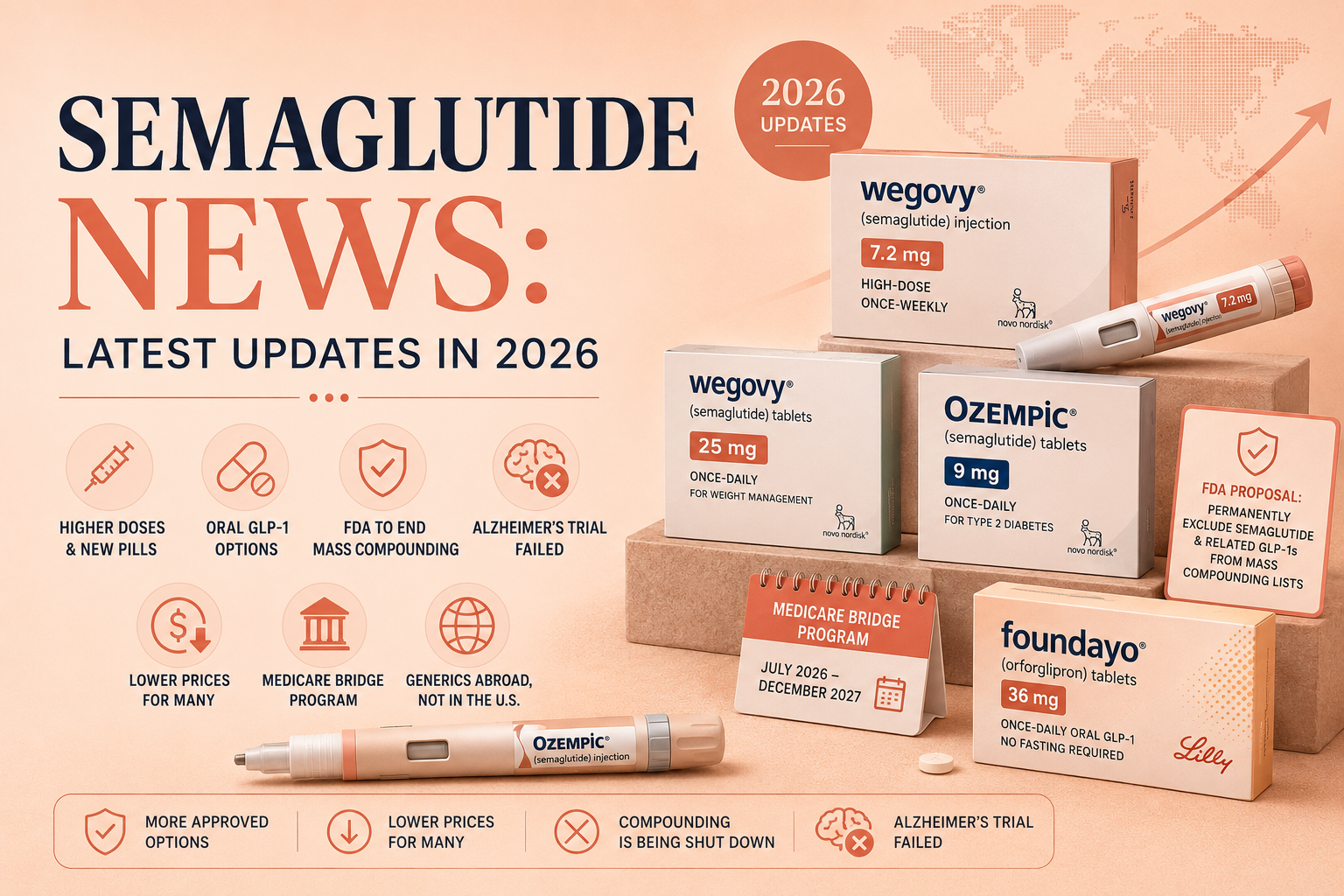
In 2026, the semaglutide story took a sharp turn away from social media hype and toward tangible shifts in treatment: a stronger weekly shot, two new pill options, and a GLP-1 rival that skips the rigid fasting rules. But the year also delivered a harsh reset as the FDA moved to permanently end mass compounding, Medicare opened a temporary coverage bridge, and a high-profile Alzheimer’s trial collapsed.
Semaglutide News: Latest Updates in 2026
If your algorithm served you semaglutide news this year, it probably served you the wrong parts. The real story: a stronger weekly injection, two new pill formats, a rival oral GLP‑1 that needs no fasting, the FDA moving to permanently end mass compounding, and a high‑profile Alzheimer’s trial that failed. Prices fell for many self‑pay patients, and Medicare opened a temporary coverage bridge.
Quick Answer
Semaglutide’s biggest updates in 2026: a high‑dose Wegovy injection, two new oral pills (one requiring no fasting), the FDA moving to end mass compounding, and a failed Alzheimer’s trial.
- 1Wegovy HD (7.2 mg injection) and the oral Wegovy Pill (25 mg) for weight loss.
- 2A rebranded Ozempic Pill replacing Rybelsus for type 2 diabetes.
- 3Eli Lilly’s Foundayo (orforglipron) — a once‑daily oral GLP‑1 pill that skips semaglutide’s strict fasting rules.
- 4FDA proposal to permanently exclude semaglutide and related GLP‑1s from mass‑compounding lists, shutting down the legal pathway for cheap copies.
- 5Semaglutide failed Phase 3 Alzheimer’s trials, correcting earlier observational hype.
Out‑of‑pocket costs dropped, the Medicare Bridge program launched, and patents expired abroad — but no generic semaglutide is legally available in the United States.
The 2026 Treatment Landscape
Higher Doses and New Pills
The FDA cleared three new semaglutide products in early 2026:
- 1Wegovy HD 7.2 mg injection (approved March 19) is for people already on the standard 2.4 mg dose who need additional weight reduction. The STEP UP trial showed roughly 21% mean weight loss at 72 weeks.
- 2Wegovy Pill — oral semaglutide 25 mg — launched in January after late‑2025 approval. The OASIS 4 trial reported a mean weight loss of 13.6% over 64 weeks; those who stayed on treatment lost 16.6%.
- 3Ozempic Pill replaced the older Rybelsus brand for type 2 diabetes (approved February, available May 2026). It comes in 1.5 mg, 4 mg, and 9 mg tablets with improved absorption.
A No‑Fasting Competitor
Eli Lilly’s Foundayo (orforglipron) was approved April 1, 2026, and launched the same week. It’s a once‑daily oral GLP‑1 for weight management that can be taken any time of day, with or without food — no empty‑stomach, small‑water‑sip rules. In the ATTAIN‑1 trial, the highest dose produced an average 27‑pound weight loss. For anyone who couldn’t stick with semaglutide’s rigid morning routine, this is a genuine functional shift.
CagriSema Loses a Head‑to‑Head
CagriSema, a once‑weekly shot that combines semaglutide and cagrilintide (which mimics the amylin hormone that also regulates appetite and digestion), generated enormous expectations. The REDEFINE 1 trial did show strong weight loss numbers — but REDEFINE 4 is the defining data point. That trial directly compared CagriSema to tirzepatide 15 mg (Zepbound). CagriSema achieved 23% weight loss at 84 weeks — and missed its primary endpoint: non‑inferiority against tirzepatide. Zepbound came out ahead. An FDA decision is expected late 2026, but the “next big thing” narrative collapsed the moment the head‑to‑head results hit.
Generics Abroad, Not in the U.S.
Semaglutide patents expired in March 2026 in India, China, Brazil, Canada, and several other countries, covering roughly 40% of the world’s population. Biosimilars in those markets could push prices as low as $7–0 per dose. In the United States, however, no generic semaglutide is FDA‑approved. U.S. patents run until at least 2032, and personal importation is allowed only under narrow, documented circumstances. Any website offering “generic Ozempic” to Americans is not selling an FDA‑reviewed product.
How Semaglutide Works (30‑Second Refresher)
All semaglutide products are GLP‑1 receptor agonists. They mimic a gut hormone that triggers insulin release, slows stomach emptying, and curbs appetite — improving blood sugar and, for many, producing meaningful weight loss. The FDA‑approved brands differ only by indication, dose, and delivery:
- 1Ozempic (injection and pill) — for type 2 diabetes, with cardiovascular and kidney protection indications.
- 2Wegovy (injection and pill) — for chronic weight management, including the high‑dose injection and oral tablet.
None of these are interchangeable with compounded or “research‑use” products.
When Trials Don’t Match the Hype
- 1Alzheimer’s failure. Observational studies had suggested a 40–70% lower dementia risk with GLP‑1 use. The EVOKE and EVOKE+ Phase 3 trials of oral semaglutide in early Alzheimer’s disease reported results in March 2026. Semaglutide showed no clinical benefit for cognition or function. The drug was pharmacologically active and caused weight loss — but it didn’t slow cognitive decline. That’s a major correction to earlier hopes.
- 1Compounding safety. Mass compounding of semaglutide depended on FDA‑declared drug shortages, which were resolved by early 2025. In April 2026, the FDA proposed permanently removing semaglutide, tirzepatide, and liraglutide from the list of active ingredients that large outsourcing facilities may use — effectively closing the last major legal pathway for mass‑produced copies. The comment period was extended to July 30, 2026. Novo Nordisk’s litigation has alleged impurities as high as 86% in some compounded products. The cheap compounded semaglutide subscriptions are being shut down.
Talk to Your Doctor — Not the Internet
This article is for general education only and does not replace medical advice from a licensed healthcare professional.
If you’re considering semaglutide or already taking it, bring these points to your next appointment:
- 1Whether the new higher‑dose Wegovy injection or the oral Wegovy fits your situation — neither is automatically better.
- 2How your insurance or Medicare coverage may shift, especially given the temporary Medicare GLP‑1 Bridge program (July 2026 through December 2027).
- 3That compounded semaglutide isn’t FDA‑reviewed and, as of mid‑2026, is increasingly unavailable through legal channels. Do not assume an online source is safe.
- 4Symptoms of pancreatitis (severe abdominal pain, nausea, vomiting), gallbladder problems (pain, jaundice), or severe low blood sugar require emergency medical attention. These are rare but potentially life‑threatening — treat them seriously.
What the Internet Keeps Getting Wrong
- 1Ozempic isn’t a generic term. It’s a diabetes brand. Wegovy is for weight management. Same active ingredient, different FDA approvals.
- 2“Ozempic face” is not a medical diagnosis. It’s facial fat loss from rapid weight reduction — possible with any significant weight drop, not specific to GLP‑1s.
- 3Celebrity before‑after photos prove nothing. They can’t confirm which drug, dose, or even if a GLP‑1 was used.
- 4Compounded semaglutide is not an FDA‑approved product. The legal and safety landscape shifted fundamentally in 2026.
- 5No U.S. generics exist. Overseas generics don’t have U.S. safety or legal clearance.
- 6Semaglutide failed the Alzheimer’s trial. Early observational signals were not confirmed in Phase 3.
- 7Animal and cell‑culture data are not human proof. Many viral claims about peptides rest entirely on preclinical studies.
- 8CagriSema didn’t beat Zepbound. In its own head‑to‑head trial, it lost.
- 9The Medicare Bridge isn’t permanent. It runs July 2026 through December 2027.
- 10Semaglutide is no longer the only story. Tirzepatide, orforglipron, and pipeline candidates are reshaping the landscape.
What This Means for Patients in 2026
Semaglutide isn’t fading. It’s maturing into the widest array of legitimate treatment options ever — more FDA‑cleared forms, lower cash prices, and a rival that solved a daily headache. At the same time, a high‑profile Alzheimer’s trial failed, the combination shot lost head‑to‑head, and unregulated compounding is being shut down.
FAQ
No. Not until 2032 at the earliest. If an American website says “generic Ozempic,” it’s not selling anything the FDA has reviewed.
Ozempic (injection and pill) is approved for type 2 diabetes. Wegovy (injection and pill) is approved for weight management. Both contain semaglutide but carry separate FDA approvals and distinct dosing. The new Ozempic pill replaces Rybelsus; the new Wegovy pill is an oral option for weight loss.
Yes. The EVOKE and EVOKE+ Phase 3 trials found no cognitive benefit. Earlier observational signals did not translate into clinical efficacy.
Novo Nordisk cut its self‑pay price to $349/month for most strengths (the 2 mg Ozempic dose remains at $499), with an introductory offer of 99/month for starter doses. A list‑price reduction to $675/month takes effect in January 2027. The temporary Medicare GLP‑1 Bridge program can bring copays to $50/month for those who qualify.
CagriSema combines semaglutide and cagrilintide in one weekly shot. In a head‑to‑head trial, Zepbound (tirzepatide) produced superior weight loss. CagriSema is not yet approved; an FDA decision is expected late 2026.
The large‑scale compounding model is being shut down. As of mid‑2026, the FDA is finalizing a rule that would remove the last major legal pathway. Small‑scale compounding for an individual patient with a documented medical need may still occur in limited circumstances, but the direct‑to‑consumer subscription model is largely over.
Dr. Diana Munteanu
Comments (0)
Be the first to comment on this article.
