
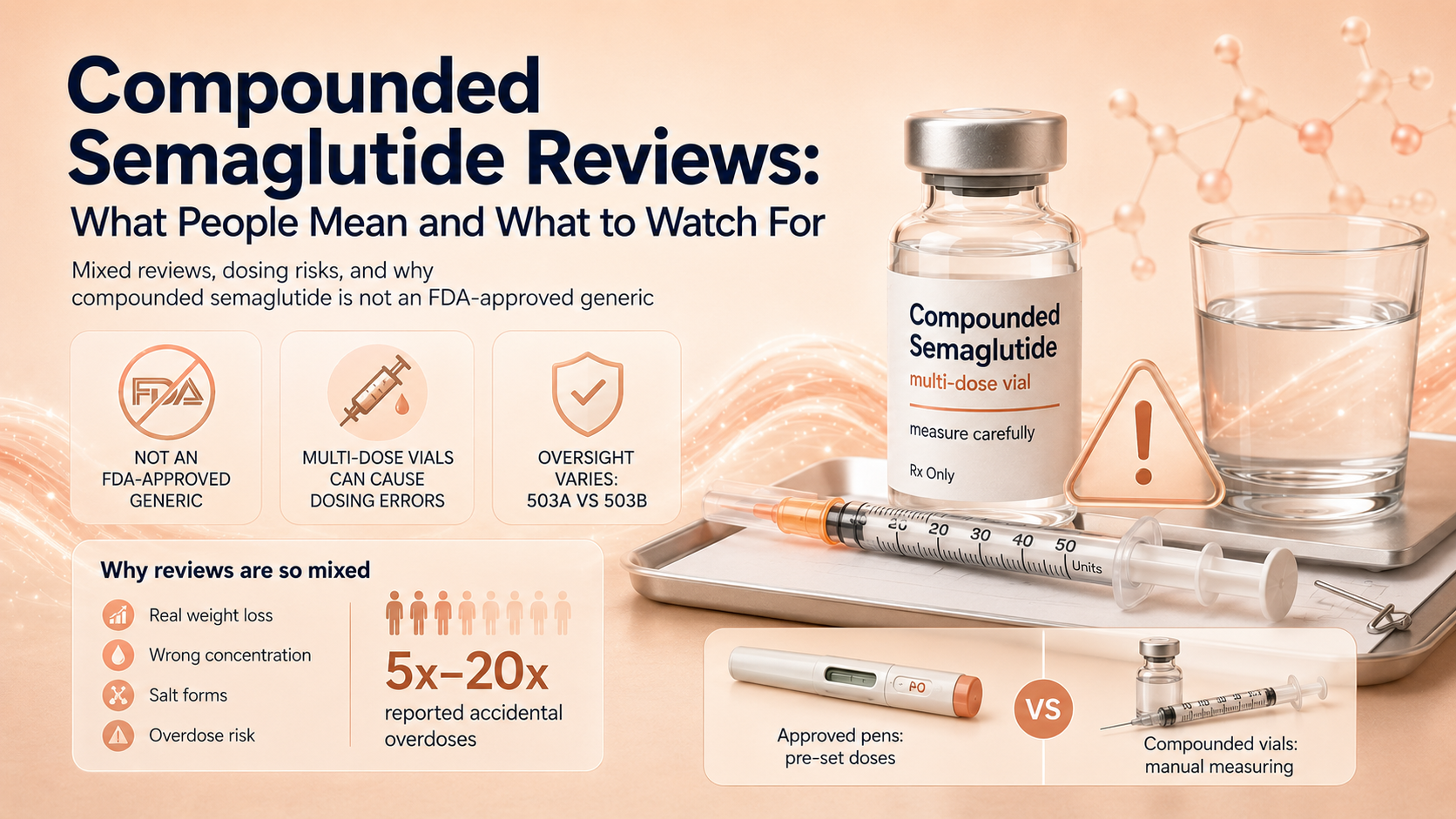
Compounded Semaglutide Reviews: What People Mean and What to Watch For
Scroll through compounded semaglutide reviews and you’ll find glowing weight-loss success stories right next to harrowing accounts of accidental overdoses that ended in the ER. The gap between those experiences isn’t just about how different bodies respond—it’s about what “compounded” can actually mean, from sterile, professionally dosed injections to degraded salt forms patients measure themselves at home. Understanding which one you’re reading about is the first step to making sense of the mixed reviews.
Online, compounded semaglutide reviews live at two extremes — effusive weight-loss stories and accounts of accidental overdoses that end in the ER. The reason isn’t just individual biology; it’s that “compounded semaglutide” can mean a sterile, professionally dosed injection from an FDA-regulated facility or a degraded salt form measured with a syringe by a patient at home. Both are called the same thing.
Quick Answer: What You Need to Know
Compounded semaglutide is not an FDA-approved generic. It’s made from bulk ingredients that have never been reviewed for safety, effectiveness, or manufacturing quality. Patient reports include real weight loss alongside dosing accidents and infections, but most online testimonials skip the details that matter — product source, purity, and whether the dose was even right. As of 2026, the FDA is actively blocking most compounding of semaglutide; any product still available sits in contested legal territory.
The Science: What Semaglutide Actually Does
Semaglutide mimics a gut hormone (GLP-1) to slow stomach emptying, boost fullness, and nudge insulin up while lowering glucagon. The result is reduced appetite and, often, significant weight loss. Three FDA-approved brands contain it: Ozempic and Rybelsus for type 2 diabetes, and Wegovy for chronic weight management. None are generics — anything calling itself a generic is compounded.
Semaglutide is frequently confused with tirzepatide (Mounjaro, Zepbound), but tirzepatide hits both GIP and GLP-1 receptors. In the head-to-head SURMOUNT-5 trial, tirzepatide delivered 20.2% weight loss at 72 weeks versus 13.7% for semaglutide. Any headline that treats them as interchangeable misses a real clinical gap.
What “Compounded” Really Means — and Why It Matters
Compounded semaglutide flooded the market only because Wegovy and Ozempic were listed in shortage. The FDA declared that shortage resolved on February 21, 2025. Federal grace periods for pharmacies to stop making semaglutide expired in April and May 2025. Since then, the agency has sent over 100 warning letters and pursued permanent rules to halt compounding from bulk substances.
Two types of compounding pharmacies exist, with very different oversight:
- 1503A pharmacies — state-regulated, require a patient-specific prescription, and do not have to meet federal cGMP manufacturing standards or report adverse events.
- 2503B outsourcing facilities — FDA-regulated, cGMP-compliant, and required to report adverse events.
Many telehealth services source semaglutide from 503A pharmacies, which do not report adverse events to the FDA. The real safety picture is therefore undercounted: by April 2025, the agency had received 520 adverse event reports linked to compounded semaglutide — a number experts believe captures only a fraction of incidents.
The product itself can differ dangerously. Some compounders use semaglutide sodium or semaglutide acetate, salt forms chemically distinct from the base semaglutide in approved drugs. The FDA has stated these salts have not been shown safe or effective. Dosing adds another layer of risk: compounded semaglutide usually comes in multi-dose vials that patients have to measure with insulin syringes. The FDA has reports of people accidentally injecting 5 to 20 times the intended dose — triggering severe vomiting, dehydration, and emergency room visits.
What Clinical Trials Show vs. What Online Reviews Claim
Wegovy’s clinical data is solid. In the STEP 1 trial, people lost an average of 14.9% of their body weight at 68 weeks, and 86% shed at least 5%. Two-year data from STEP 5 confirmed that loss was maintained while treatment continued.
No large, controlled trials exist for compounded semaglutide. Positive reviews often describe real appetite suppression and weight loss — the active ingredient, if made correctly, still works on GLP-1 receptors. But glowing anecdotes can’t confirm the absence of contamination, correct dosing, or long-term safety. Negative reports of extreme nausea, infections, or no effect frequently trace back to dosing mistakes, degraded peptide, or the unapproved salt forms. When you read a review, you rarely know which of those variables was at play.
Talking to a Doctor: Safety Signals You Can’t Ignore
If you’ve used any form of semaglutide and develop severe abdominal pain that spreads to your back, stop and seek emergency care — this could be pancreatitis. Other red flags include signs of gallbladder trouble (fever, yellowing skin, severe upper-right abdominal pain) and persistent vomiting or diarrhea that causes dehydration.
The better question for anyone considering compounded semaglutide isn’t “does it work?” but “can I verify exactly what is in this vial and where it was made?”. A prescribing clinician should be able to confirm the source pharmacy’s license, whether the product uses the FDA-approved base form or a salt, and the exact concentration per milliliter. Measuring errors erase the safety margin that clinical trials established.
You can read more about the range of reported semaglutide side effects, including those seen with the FDA-approved formulations, to understand what to monitor and when to involve a doctor.
What the Internet Gets Wrong About Compounded Semaglutide
Several myths consistently warp the conversation:
- 1“It’s just a generic.” It isn’t. The FDA hasn’t approved any generic semaglutide. Compounded products are not tested for bioequivalence, purity, or sterility.
- 2“Ozempic is the weight-loss drug.” Ozempic is FDA-approved for type 2 diabetes, not weight loss. Wegovy uses the same active ingredient but carries the formal weight-loss indication and a different dosing schedule. Conflating them gives patients the wrong impression about what’s licensed.
- 3“Ozempic face is a medical side effect.” It’s a social-media term for facial volume loss from rapid weight loss — something that happens with any cause of fast weight reduction. The Cleveland Clinic and Mayo Clinic both emphasize it isn’t a clinical diagnosis. Framing it as a unique drug side effect promotes unnecessary worry.
- 4“Semaglutide and tirzepatide are the same.” Tirzepatide’s added GIP agonism drove significantly greater weight loss in head-to-head trials. Confusing the two can lead to unrealistic expectations or dangerous dosing assumptions.
- 5“If I can buy it at a med spa, it must be safe and legal.” Current enforcement means many products are being sold in violation of FDA orders. Availability is not proof of safety or legality.
Bottom Line
Compounded semaglutide occupies a high-risk middle zone between an FDA-approved medication and an unregulated research chemical. The active peptide can produce real weight loss, but the problems that generate alarming reviews — unfamiliar salt forms, manufacturing lapses, and disastrous dosing errors — are built into a system with far less oversight than patients realize. In 2026, the legal window for these products has largely closed, and what remains is often unsanctioned. The safest path is an approved product prescribed by a licensed clinician who can tell you exactly what you’re injecting.
FAQ
Because the products vary sharply. One person receives a sterile, correctly dosed solution from a 503B facility; another injects a degraded salt form from a lightly regulated pharmacy. Dosing errors alone can turn manageable appetite suppression into a days-long nausea crisis.
In SURMOUNT-5, tirzepatide led to about 20.2% body weight loss over 72 weeks versus 13.7% for semaglutide. Both are injected weekly, but tirzepatide’s dual GIP/GLP-1 mechanism appears stronger. Any switch should be discussed with a doctor, not driven by online comparisons.
Approved semaglutide comes in single-dose pens with fixed, pre-set doses. Compounded forms usually arrive as multi-dose vials that you measure and inject with an insulin syringe. The FDA has documented patients accidentally taking 5 to 20 times the intended dose. If you and your doctor ever consider this route, absolute clarity on concentration and syringe markings is non-negotiable. For a detailed breakdown of the standard Wegovy titration, see our resource on semaglutide dosing.
Some med spas and online platforms still advertise “semaglutide near me” despite tightening FDA enforcement. In the United States, semaglutide in any form is prescription-only. Any source offering it without a valid prescription is operating outside legal and safety guardrails.
Beyond common nausea and constipation, seek immediate help for signs of pancreatitis (intense stomach pain that spreads to the back), gallbladder attacks, or an allergic reaction. Our detailed side effects guide covers both common and rare warnings, including the thyroid C-cell tumor boxed warning — which is based on rodent studies and not confirmed in humans.
Dr. Diana Munteanu
Comments (0)
Be the first to comment on this article.
