
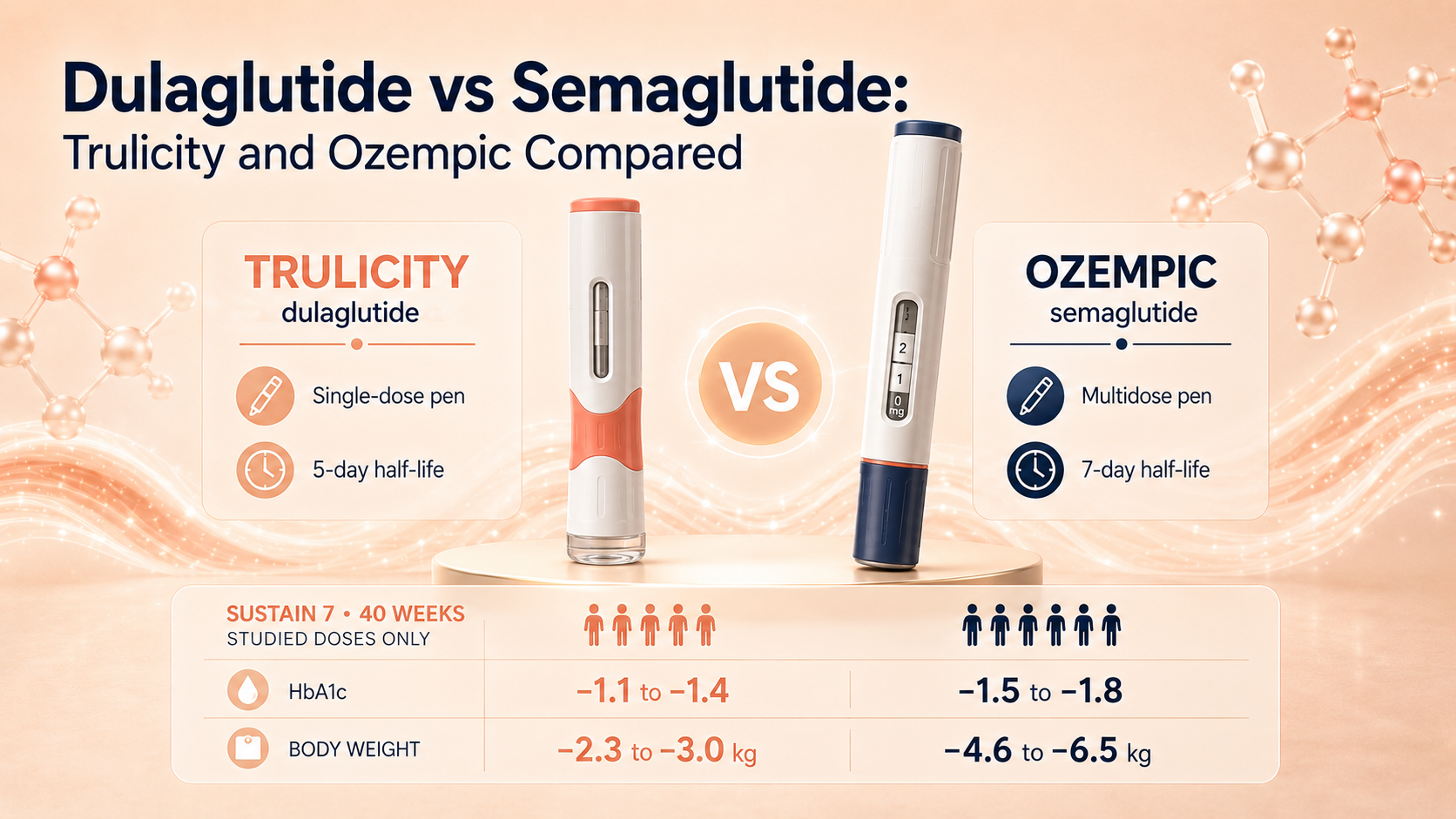
Dulaglutide vs Semaglutide: Trulicity and Ozempic Compared
Comparing dulaglutide vs semaglutide (Trulicity vs Ozempic) highlights two leading once-weekly GLP-1 receptor agonists designed to improve blood sugar control in type 2 diabetes while reducing cardiovascular risk. While sharing similar mechanisms of action and injection schedules, head-to-head studies between semaglutide vs Trulicity reveal notable differences in HbA1c reduction, weight loss capacity, and pen engineering. To determine which is better Trulicity or Ozempic for your clinical goals, here is a detailed breakdown of their efficacy, device design, and safety profiles.
<strong>Scope Note:</strong> This article primarily compares once-weekly Trulicity and Ozempic injections because the direct SUSTAIN 7 head-to-head trial evaluated those formulations. Ozempic is also available in the United States as a once-daily tablet, but that formulation was not studied against Trulicity in SUSTAIN 7.
<strong>Quick Answer:</strong> In the 40-week SUSTAIN 7 trial, injectable semaglutide produced greater average reductions in HbA1c and body weight than dulaglutide at the doses studied. However, the trial did not compare today’s maximum doses of Ozempic 2 mg and Trulicity 4.5 mg. The medications also differ in FDA indications, available formulations, injection devices, and cardiovascular and kidney-related labeling.
Dulaglutide, sold as Trulicity, and semaglutide, sold as Ozempic, are glucagon-like peptide-1 receptor agonists used to improve blood glucose control in people with type 2 diabetes.
Both drugs stimulate insulin secretion and reduce glucagon secretion in a glucose-dependent manner. They also delay gastric emptying and can reduce appetite and body weight.
However, dulaglutide and semaglutide are different molecules. They are not interchangeable on a milligram-for-milligram basis, and differences in clinical evidence, formulations, approved uses, and delivery devices may affect which option a clinician recommends.
For an overview of semaglutide products, see our guide to semaglutide brands and approved uses.
Trulicity vs Ozempic: Key Differences
Manufacturer
Eli Lilly and Company
Novo Nordisk
Drug class
GLP-1 receptor agonist
GLP-1 receptor agonist
U.S. formulations
Once-weekly injection
Once-weekly injection and once-daily tablets
Type 2 diabetes indication
Adults and children aged 10 years and older
Adults
Adult injection starting dose
0.75 mg once weekly
0.25 mg once weekly for four weeks
Adult injection maintenance doses
1.5, 3, or 4.5 mg once weekly, depending on response
0.5, 1, or 2 mg once weekly, depending on glycemic control
Maximum injection dose
4.5 mg once weekly
2 mg once weekly
Cardiovascular indication
Adults with type 2 diabetes and established cardiovascular disease or multiple cardiovascular risk factors
Ozempic injection: adults with type 2 diabetes and established cardiovascular disease. Ozempic tablets: adults with type 2 diabetes at high cardiovascular risk
Specific CKD outcome indication
No separate FDA indication for reducing major kidney outcomes
Ozempic injection is indicated to reduce the risk of sustained eGFR decline, end-stage kidney disease, and cardiovascular death in adults with type 2 diabetes and chronic kidney disease
Injection device
Prefilled, disposable single-dose pen
Prefilled multidose pen requiring a new disposable needle for each injection
Approximate elimination half-life
5 days
1 week
FDA-approved specifically for weight loss
No
No
Although both medications can reduce body weight in people with type 2 diabetes, neither Trulicity nor Ozempic is FDA-approved specifically for chronic weight management. Wegovy is the semaglutide brand with a weight-management indication.
Which Is Better: Trulicity or Ozempic?
The clearest direct comparison comes from SUSTAIN 7, a randomized, open-label phase 3b trial involving 1,201 adults whose type 2 diabetes was inadequately controlled with metformin.
Participants received one of four once-weekly injectable treatments for 40 weeks:
- 1Semaglutide 0.5 mg
- 2Dulaglutide 0.75 mg
- 3Semaglutide 1 mg
- 4Dulaglutide 1.5 mg
The study compared semaglutide 0.5 mg with dulaglutide 0.75 mg and semaglutide 1 mg with dulaglutide 1.5 mg.
SUSTAIN 7 Results
Semaglutide 0.5 mg
−1.5 percentage points
−4.6 kg
Dulaglutide 0.75 mg
−1.1 percentage points
−2.3 kg
Semaglutide 1 mg
−1.8 percentage points
−6.5 kg
Dulaglutide 1.5 mg
−1.4 percentage points
−3.0 kg
At both dose comparisons, semaglutide produced statistically greater reductions in HbA1c and body weight.
This supports the conclusion that injectable semaglutide was more effective for these two outcomes at the doses and in the population studied. It does not prove that Ozempic is universally “better” for every patient.
The trial involved adults taking metformin and lasted 40 weeks. Individual results can differ according to baseline HbA1c, body weight, treatment adherence, other medications, tolerability, and health conditions.
What About Ozempic 2 mg and Trulicity 4.5 mg?
The higher doses currently available were approved after SUSTAIN 7:
- 1Dulaglutide 3 and 4.5 mg were evaluated against dulaglutide 1.5 mg in AWARD-11.
- 2Semaglutide 2 mg was evaluated against semaglutide 1 mg in SUSTAIN FORTE.
Both studies found additional glycemic benefit from the higher dose of the respective medication. However, neither study directly compared semaglutide 2 mg with dulaglutide 4.5 mg.
Results from separate trials cannot be treated as a reliable head-to-head comparison because the participants, baseline characteristics, statistical methods, and study conditions differed.
Therefore, SUSTAIN 7 should not be used to claim that Ozempic 2 mg has been proven superior to Trulicity 4.5 mg.
For another within-class comparison, read liraglutide vs semaglutide.
Cardiovascular and Kidney Indications
Both medications have evidence supporting cardiovascular risk reduction, but their U.S. indications are not identical.
Trulicity
Trulicity is indicated to reduce the risk of cardiovascular death, nonfatal heart attack, or nonfatal stroke in adults with type 2 diabetes who have:
- 1Established cardiovascular disease; or
- 2Multiple cardiovascular risk factors
This indication is based largely on the REWIND cardiovascular outcomes trial.
Ozempic Injection
Ozempic injection is indicated to reduce major cardiovascular events in adults with type 2 diabetes and established cardiovascular disease.
It also has a separate indication for reducing the risk of sustained kidney-function decline, end-stage kidney disease, and cardiovascular death in adults with type 2 diabetes and chronic kidney disease.
Ozempic Tablets
Once-daily Ozempic tablets are indicated to reduce major cardiovascular events in adults with type 2 diabetes who are at high risk for such events.
These labeling differences may be clinically important. A general statement that both drugs provide the same cardiovascular or kidney protection would be inaccurate.
Dosing and Device Design
Trulicity Injection
Trulicity is supplied in disposable, prefilled single-dose pens.
For each dose, the patient:
- 11. Removes the base cap.
- 22. Places the clear base against the skin.
- 33. Unlocks the pen.
- 44. Presses the injection button.
The needle is contained within the device and begins retracting after delivery. No separate needle needs to be attached, and each pen is discarded after one use.
This design may be helpful for people who prefer fewer preparation steps. However, patients still need instruction on correct use and safe disposal.
Ozempic Injection
Ozempic injection is supplied in multidose pens. A new disposable needle must be attached before every injection.
The patient uses the dose selector to choose the labeled dose provided by that pen. Patients should not attempt to create unapproved intermediate doses by counting clicks.
The pen is reused until its labeled doses have been administered, while each needle is used only once.
Ozempic Tablets
Ozempic tablets are taken once daily rather than once weekly.
They must be swallowed whole on an empty stomach after waking with no more than four ounces of plain water. Patients must then wait at least 30 minutes before eating, drinking, or taking other oral medications.
Because SUSTAIN 7 studied injections, its results should not be presented as a direct comparison between Trulicity and Ozempic tablets.
Side Effects and Tolerability
Both medications commonly cause gastrointestinal effects, including:
- 1Nausea
- 2Diarrhea
- 3Vomiting
- 4Abdominal discomfort or pain
- 5Constipation
- 6Reduced appetite
In SUSTAIN 7, gastrointestinal adverse events were reported by:
- 143% of participants receiving semaglutide 0.5 mg
- 244% receiving semaglutide 1 mg
- 333% receiving dulaglutide 0.75 mg
- 448% receiving dulaglutide 1.5 mg
These figures show that gastrointestinal-event rates varied according to the treatment and dose. The trial did not establish that one medication is always easier to tolerate.
Both medications use gradual dose escalation to reduce gastrointestinal reactions. Persistent vomiting, inability to maintain hydration, severe abdominal pain, or symptoms that interfere with nutrition require medical guidance rather than simply waiting for the body to adjust.
See our guide to semaglutide side effects for a more detailed discussion.
Important Safety Considerations
Trulicity and Ozempic both carry boxed warnings concerning thyroid C-cell tumors observed in rodents. It is unknown whether either medication causes medullary thyroid carcinoma in humans.
Both are contraindicated in people with:
- 1A personal or family history of medullary thyroid carcinoma; or
- 2Multiple Endocrine Neoplasia syndrome type 2
Other important concerns can include:
- 1Acute pancreatitis
- 2Severe gastrointestinal reactions
- 3Gallbladder disease
- 4Acute kidney injury related to dehydration
- 5Hypoglycemia when combined with insulin or a sulfonylurea
- 6Diabetic retinopathy complications
- 7Serious hypersensitivity reactions
- 8Possible residual stomach contents before anesthesia or deep sedation
Neither medication is recommended for patients with severe gastroparesis. Patients should tell surgical and anesthesia teams that they use a GLP-1 receptor agonist before a planned procedure.
This is not a complete list of warnings. Treatment decisions should be based on the current prescribing information and an individual medical assessment.
What Patient Reviews Can and Cannot Show
Personal reports may help readers understand practical issues such as pen use, nausea, appetite changes, or treatment routines.
However, reviews cannot determine which medication is medically more effective or safer. Differences in dose, diabetes severity, diet, other medications, and treatment duration make individual experiences unsuitable for a controlled comparison.
Our collection of semaglutide reviews should therefore be read as patient experience—not as proof that Ozempic will produce a particular result.
Dulaglutide vs Semaglutide: Final Comparison
For the doses tested in SUSTAIN 7, injectable semaglutide produced greater average reductions in HbA1c and body weight than dulaglutide.
That result does not automatically determine the best treatment for an individual patient. Other relevant considerations include:
- 1Cardiovascular history
- 2Chronic kidney disease
- 3Baseline and target HbA1c
- 4Existing diabetic retinopathy
- 5Gastrointestinal tolerance
- 6Preference for a single-use pen, multidose pen, or tablet
- 7Insurance coverage and availability
- 8Other diabetes medications
- 9Previous response to GLP-1 treatment
Trulicity may offer a simpler single-use injection device and a cardiovascular indication that includes adults with multiple risk factors. Ozempic produced greater HbA1c and weight reductions in the direct SUSTAIN 7 comparisons, is available in injectable and oral forms, and its injection has a specific kidney-outcomes indication.
The final choice should be made with a healthcare professional rather than from a single comparison metric.
Frequently Asked Questions
Is dulaglutide the same as semaglutide?
No. Dulaglutide and semaglutide are different GLP-1 receptor agonists. They have related mechanisms but different molecular structures, doses, devices, formulations, and FDA indications.
Does Ozempic cause more weight loss than Trulicity?
In SUSTAIN 7, semaglutide 0.5 and 1 mg produced greater average weight reductions than dulaglutide 0.75 and 1.5 mg. The trial did not compare Ozempic 2 mg directly with Trulicity 4.5 mg.
Are Trulicity and Ozempic approved for weight loss?
No. Both are diabetes medications that can reduce body weight, but neither brand has a specific FDA weight-management indication. Wegovy is a semaglutide product approved for chronic weight management.
Can someone switch from Trulicity to Ozempic?
A clinician may recommend switching in some circumstances, but the drugs are not interchangeable milligram for milligram. The starting schedule may depend on the previous dose, treatment gap, glycemic control, and gastrointestinal tolerance.
Which pen is easier to use?
Trulicity uses a disposable single-dose autoinjector with no separate needle attachment. Ozempic injection uses a multidose dial pen requiring a new needle for every injection. Ease of use depends on the individual’s vision, dexterity, training, and preferences.
Sources
- 11. SUSTAIN 7 head-to-head trial
- 22. Current Trulicity U.S. prescribing information
- 33. Ozempic injection U.S. prescribing information
- 44. Ozempic tablets U.S. prescribing information
- 55. AWARD-11 higher-dose dulaglutide trial
- 66. SUSTAIN FORTE semaglutide 2 mg trial
Dr. Diana Munteanu
Comments (0)
Be the first to comment on this article.
