
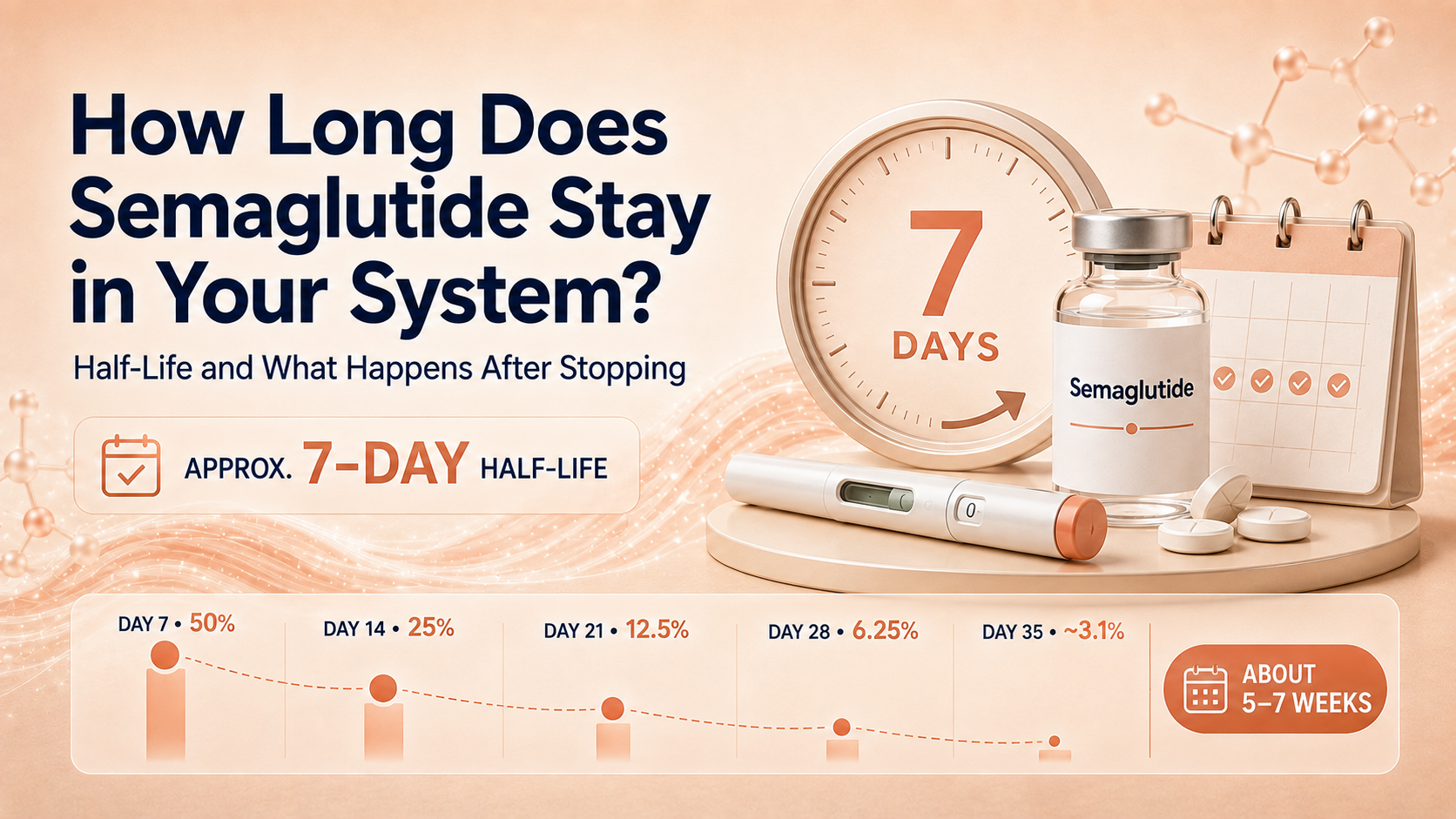
How Long Does Semaglutide Stay in Your System? Half-Life and What Happens After Stopping
With an elimination half-life of approximately one week, semaglutide remains in your system for about 5 weeks after stopping—and up to 5 to 7 weeks for Wegovy 2.4 mg. Learn what to expect during systemic clearance.
Quick Answer
Semaglutide has an elimination half-life of approximately one week. FDA prescribing information states that it remains in the circulation for about five weeks after the last Ozempic injection or semaglutide tablet dose. After the last 2.4 mg Wegovy injection, it may remain in the circulation for approximately five to seven weeks. These are estimates—not an exact date when every trace of the medication disappears or when its effects stop.
If you are currently taking or planning to discontinue semaglutide, understanding its persistence in your body is critical. Whether you are preparing for an upcoming procedure, managing side effects, or transitioning off therapy, knowing how long semaglutide stays in your system helps set more realistic expectations for your care plan.
To understand why clearance takes several weeks, it helps to start with what semaglutide is—a long-acting glucagon-like peptide-1 (GLP-1) receptor agonist engineered specifically for extended stability in human blood plasma.
Understanding the Semaglutide Half-Life
A key pharmacokinetic measure used to estimate how long a drug remains in the body is its elimination half-life—the time required for its concentration in the bloodstream to decrease by 50%.
FDA prescribing information lists the elimination half-life of semaglutide as approximately 7 days (1 week).
Why Does Semaglutide Persist for So Long?
Unlike natural human GLP-1, which breaks down within minutes of release, semaglutide features key molecular modifications:
- 11. <strong>Albumin Binding:</strong> A hydrophobic fatty acid chain attached to the peptide backbone allows semaglutide to bind extensively to circulating plasma albumin, protecting it from rapid elimination by the kidneys.
- 22. <strong>Enzymatic Resistance:</strong> Structural amino acid substitutions shield the molecule from rapid degradation by the dipeptidyl peptidase-4 (DPP-4) enzyme.
Because of this approximately 7-day half-life, steady-state exposure is generally reached after 4 to 5 weeks of regular dosing—for both once-weekly injections and once-daily semaglutide tablets. After treatment stops, circulating concentrations decline gradually according to the same approximate half-life.
Simplified Semaglutide Half-Life Timeline
Pharmacokinetic principles state that most of a drug is eliminated after approximately <strong>5 half-lives</strong>, when circulating levels drop to about 3.1% of the original concentration.
Time From the Reference Level
Half-Lives Passed
Estimated Proportion Remaining
<strong>Day 7</strong>
1
<strong>50%</strong>
<strong>Day 14</strong>
2
<strong>25%</strong>
<strong>Day 21</strong>
3
<strong>12.5%</strong>
<strong>Day 28</strong>
4
<strong>6.25%</strong>
<strong>Day 35</strong>
5
<strong>Approximately 3.1%</strong>
<em>This table is a simplified mathematical illustration, not a measurement of an individual patient’s blood concentration. Dose, treatment duration, absorption, and individual pharmacokinetics affect the absolute amount present. Clinical effects do not necessarily correspond to these percentages.</em>
What May Happen After Stopping Semaglutide?
People often ask when semaglutide leaves the body and how quickly its effects change after treatment stops. These changes do not follow a rigid calendar.
As semaglutide concentrations gradually decline, appetite may increase, blood glucose control may change, and gastrointestinal adverse effects may ease. However, the timing and intensity differ between individuals and cannot be predicted from the half-life alone.
If you experienced lingering semaglutide side effects, symptoms such as nausea or indigestion may ease as systemic concentrations decrease. However, the half-life cannot predict when a particular symptom will resolve. Persistent, worsening, or severe symptoms should be discussed with a healthcare professional.
Oral vs. Injectable Formulations
Oral and injectable products differ substantially in absorption and dosing schedules. However, once semaglutide reaches the circulation, both formulations have an elimination half-life of approximately one week. FDA labeling estimates about five weeks of circulation after the last semaglutide tablet dose, while the estimate for the last 2.4 mg Wegovy injection is approximately five to seven weeks.
For a broader overview of how absorption mechanisms compare, review the detailed breakdown of oral and injectable semaglutide differences.
Surgery and Procedures
Semaglutide can delay gastric emptying, and FDA labeling describes rare postmarketing reports of pulmonary aspiration during procedures requiring general anesthesia or deep sedation. However, available evidence does not establish one universal period for stopping semaglutide before a procedure.
Current multi-society guidance indicates that many patients can continue GLP-1 therapy before elective surgery. Patients who are increasing their dose, have significant gastrointestinal symptoms, take higher doses, or have another condition that slows gastric emptying may require additional precautions. These may include a liquid-only diet for 24 hours, assessment of stomach contents, or postponement of the procedure.
Tell the surgeon and anesthesia team that you use semaglutide. Do not pause or stop the medication on your own; follow the individualized instructions provided by your surgical, anesthesia, and prescribing teams.
Pregnancy Planning Considerations
FDA prescribing information recommends discontinuing semaglutide <strong>at least 2 months prior to a planned pregnancy</strong>.
This recommendation is a clinical precaution based on semaglutide’s long washout period and potential fetal risk—not evidence that therapeutically active concentrations persist for two full months in every patient. Always discuss family planning with your prescribing physician well in advance.
Accidental Dosing and Overdose
Because semaglutide has an approximately one-week half-life, adverse effects following an overdose may be prolonged. FDA labeling states that an extended period of observation and supportive treatment may be necessary.
If you have semaglutide overdose concerns or suspect a dosing error, contact Poison Help at 1-800-222-1222 in the United States; call 911 immediately if severe or life-threatening symptoms occur.
Key Takeaways
- 1<strong>Elimination Half-Life:</strong> Semaglutide has an elimination half-life of approximately one week.
- 2<strong>Circulation Timeline:</strong> FDA labeling indicates about five weeks of circulation after the last Ozempic injection or semaglutide tablet dose.
- 3<strong>Higher Dose Clearance:</strong> After the last Wegovy 2.4 mg injection, semaglutide may remain in circulation for approximately five to seven weeks.
- 4<strong>Individual Variability:</strong> Drug concentration, side effects, appetite, and blood glucose control do not change according to one exact timetable for every patient.
- 5<strong>Clinical Supervision:</strong> Consult the appropriate healthcare team before stopping semaglutide, preparing for surgery, or planning a pregnancy.
Sources
- 11. U.S. FDA: Ozempic Prescribing Information
- 22. U.S. FDA: Wegovy Prescribing Information
- 33. U.S. FDA: Semaglutide Tablets Prescribing Information
- 44. Multi-Society Clinical Practice Guidance for GLP-1 Use During the Perioperative Period
Dr. Diana Munteanu
Comments (0)
Be the first to comment on this article.
