Is Semaglutide a Peptide? What It Is, How It's Made, and Why the 40-Amino-Acid Rule Matters
Yes: semaglutide is a 31-amino-acid peptide built on GLP-1. How it is made, why it lasts a week, peptide vs biologic vs small molecule, and why it matters.
Written by Dr. Diana Munteanu. Updated October 25, 2026.
Yes, semaglutide is a peptide: a chain of 31 amino acids that copies the human gut hormone GLP-1, with three deliberate changes that make it last a week instead of two minutes. Because it has fewer than 40 amino acids, FDA regulates it as a peptide drug rather than a biologic, which is why it has a chemical name, is made partly by yeast and partly by chemistry, and could be copied by compounding pharmacies during the shortage. It is not the kind of "peptide" sold by wellness clinics; it is a fully approved prescription medicine with trials in more than 30,000 people.
This guide explains what makes a molecule a peptide, how semaglutide is built and why each modification matters, how it differs from small-molecule drugs, biologics and research peptides, and what all of this means for you in practice: injections versus the pill, compounding, generics and cost.
Is Semaglutide a Peptide? The Short Answer
- 1Yes. Semaglutide is a synthetic peptide of 31 amino acids, 94% identical to natural GLP-1 (glucagon-like peptide-1).
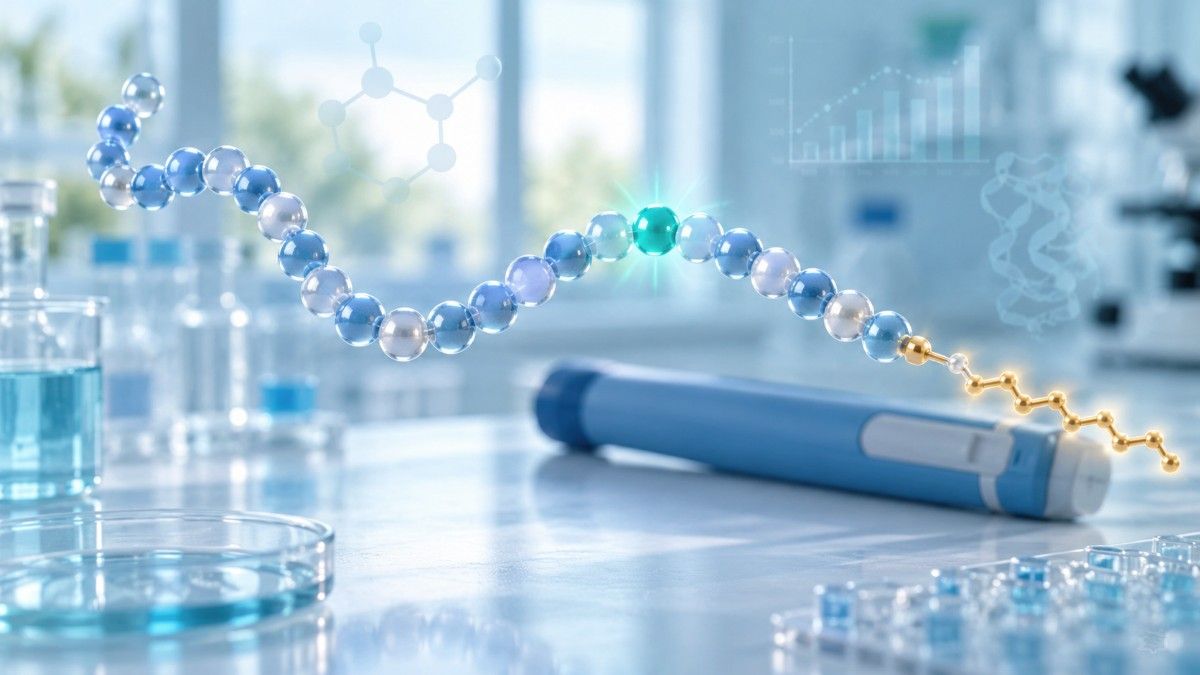
- 2Three changes from the natural hormone: a non-standard amino acid (Aib) at position 8 so enzymes cannot chop it, a C18 fatty acid chain at position 26 so it rides on albumin in the blood, and a swap at position 34 to keep the fatty acid in the right place.
- 3Result: a half-life of about 7 days instead of 2 minutes, which allows weekly injections.
- 4Regulation: under 40 amino acids = a peptide drug approved through the standard drug pathway, not a biologic. Patents on the molecule run to 2031 to 2033 in the U.S.
- 5It is the same molecule in Ozempic, Wegovy, Rybelsus and the Wegovy pill.
- 6"Peptide therapy" and "research peptides" sold online are a different category: unapproved, unverified, and not what the trials tested.
What Makes Something a Peptide
Proteins and peptides are both chains of amino acids joined by peptide bonds; the difference is length. Chemists usually call a chain of up to about 50 amino acids a peptide and anything longer a protein. Insulin, at 51 amino acids, sits at the border. GLP-1, the hormone your gut releases after a meal, is 30 or 31 amino acids long and is a textbook peptide hormone. Semaglutide is built on that template, so it is a peptide by any definition.
For regulatory purposes the line is sharper. Since 2020, FDA defines a protein as any chain of more than 40 amino acids, and regulates proteins as biologics (licensed through a BLA, with biosimilars rather than generics). Chains of 40 or fewer are peptides, approved as ordinary drugs through an NDA, with the possibility of generics once patents expire. Semaglutide's 31 amino acids put it clearly on the peptide side.
How Semaglutide Is Built
Natural GLP-1 vs semaglutide
Length
31 amino acids
31 amino acids
Position 8
Alanine, cut within minutes by the enzyme DPP-4
Aib (2-aminoisobutyric acid), which DPP-4 cannot cut
Position 26
Lysine
Lysine attached, via a linker, to an 18-carbon fatty diacid that binds tightly to albumin
Position 34
Lysine
Arginine, so the fatty acid attaches only at position 26
Half-life
About 2 minutes
About 7 days (165 hours)
Made by
Intestinal L-cells
Yeast (Saccharomyces cerevisiae) produces the peptide backbone; the fatty acid is added chemically
Receptor
GLP-1 receptor
GLP-1 receptor, with about the same potency
The fatty acid is the clever part. Albumin is the most abundant protein in blood and is too large to be filtered by the kidneys, so a drug that clings to it is protected from both kidney clearance and enzymes. Semaglutide spends most of its time bound to albumin and slowly releases to activate GLP-1 receptors in the pancreas, gut and brain. The same trick, with a shorter 16-carbon fatty acid, gives liraglutide its one-day half-life; see liraglutide vs semaglutide. For how the weekly rhythm plays out after stopping, see how long semaglutide stays in your system.
Peptide, Small Molecule or Biologic? Why the Category Matters
Three kinds of drugs compared
Size
Under about 1,000 daltons
About 4,100 daltons; 31 amino acids
Over 40 amino acids; thousands to 150,000 daltons
How it is made
Chemical synthesis
Fermentation plus chemical modification, or full chemical synthesis
Living cells
Taken by mouth?
Usually yes
Usually no; digested like food. Semaglutide pill needs an absorption enhancer (SNAC)
No
Approval pathway
NDA
NDA
BLA
Copies after patent
Generics
Generics (must match the molecule exactly)
Biosimilars
Compounding allowed?
Yes, under rules
Yes during FDA-declared shortages (ended 2025 for semaglutide)
Generally no
Why Semaglutide Is Injected, and How the Pill Works
Peptides are what digestion is designed to break down. Swallowed semaglutide meets stomach acid and protein-cutting enzymes and is mostly destroyed, and what survives is too large to cross the gut wall easily. The weekly injection under the skin bypasses all of that. The oral versions, Rybelsus and the Wegovy pill, solve the problem with SNAC, a small molecule that briefly raises the pH around the tablet and helps semaglutide cross the stomach lining; even so, only about 1% of the dose is absorbed, which is why the pill uses milligram doses many times larger than the injection and must be taken on an empty stomach with little water. See oral semaglutide vs tablets vs pills.
Semaglutide vs "Peptide Therapy"
Clinics and websites market "peptide therapy" with products such as BPC-157, CJC-1295, ipamorelin or "research grade semaglutide." Semaglutide is a peptide in the chemical sense, but it belongs to a different world from those products:
- 1Evidence: semaglutide has completed dozens of randomized trials in more than 30,000 people, including heart-outcome and liver trials. Most research peptides have one small human study or none.
- 2Approval: semaglutide is FDA-approved for type 2 diabetes, weight management, cardiovascular risk reduction and MASH. Research peptides are approved for nothing.
- 3Manufacturing: brand semaglutide is made under pharmaceutical quality rules with verified dose and purity. Vials sold as "semaglutide" online are unverified, and FDA has found wrong doses and the wrong salt form. See buying semaglutide online.
- 4Legal status: a prescription product versus unapproved substances sold with a "research use only" disclaimer.
What Being a Peptide Means for Patients
- 1Weekly dosing: the fatty-acid modification is why one injection lasts a week; a missed dose fades gradually rather than abruptly.
- 2Storage: peptides are sensitive to heat and freezing. Keep pens refrigerated and never use one that has been frozen.
- 3Compounded versions existed: because semaglutide is a peptide rather than a biologic, compounding pharmacies could legally make it during the FDA shortage (2022 to early 2025). With the shortage over, mass compounding is no longer permitted; see compounded semaglutide reviews.
- 4Generics will come, but not soon: the molecule patents run to about 2031 to 2033 in the U.S., and a generic must match the peptide exactly, which is demanding to make. Prices until then are set by Novo Nordisk; see semaglutide cost.
- 5Low allergy risk: as a near-copy of a human hormone, semaglutide rarely triggers antibodies that matter, unlike some larger biologics.
How Semaglutide Works Once It Is In
Being a peptide is about structure; what semaglutide does is about the receptor it fits. It activates GLP-1 receptors in the pancreas (more insulin when sugar is high, less glucagon), the stomach (slower emptying) and the brain (less hunger). Those three effects explain the blood sugar control, the fullness and the roughly 15% weight loss seen at the Wegovy dose. For the full mechanism and results, see semaglutide for weight loss.
When to Talk to Your Doctor
- 1If you have been offered "semaglutide" by a clinic or website that is not a licensed pharmacy dispensing a brand product
- 2If you are considering the pill instead of the injection, since absorption rules differ
- 3If you have a history of pancreatitis, gallbladder disease, or medullary thyroid cancer in the family, which affect whether any GLP-1 peptide is appropriate
- 4If you have had allergic reactions to other injectable medicines
The Bottom Line
Semaglutide is a peptide: 31 amino acids modeled on the gut hormone GLP-1, engineered to resist enzymes and cling to albumin so one dose lasts a week. Under 40 amino acids, FDA treats it as a drug rather than a biologic, which shapes how it is made, copied and compounded. The word "peptide" connects it chemically to the unregulated products sold online, but nothing else does: semaglutide is one of the most thoroughly tested medicines of the past decade. Its side effects, which come from the receptor it activates rather than from being a peptide, are listed on our side effects page.
FAQ
Yes. Semaglutide is a synthetic 31-amino-acid peptide that mimics the gut hormone GLP-1, modified to last about a week in the body. With fewer than 40 amino acids it is regulated as a peptide drug, not a biologic.
A peptide. Chemists call chains under about 50 amino acids peptides, and FDA draws the regulatory line at 40. Semaglutide's 31 amino acids make it a peptide by both standards.
Thirty-one amino acids, 94% identical to human GLP-1, plus an 18-carbon fatty acid attached at position 26 and a non-natural amino acid (Aib) at position 8. The backbone is made by yeast and the fatty acid is attached chemically.
No. Semaglutide is an FDA-approved prescription medicine tested in more than 30,000 people. "Peptide therapy" usually refers to unapproved research peptides with little or no human evidence, sold outside pharmacy channels.
Because peptides are digested like food. The injection bypasses the gut; the Rybelsus and Wegovy tablets use an absorption enhancer (SNAC) and still absorb only about 1% of the dose, which is why they need much larger milligram amounts.
Sources
- 1Discovery of the Once-Weekly Glucagon-Like Peptide-1 (GLP-1) Analogue Semaglutide, J Med Chem, 2015
- 2The Discovery and Development of Liraglutide and Semaglutide, Front Endocrinol, 2019
- 3Definition of the Term "Biological Product": final rule (40 amino acid threshold), Federal Register, February 2020
- 4Ozempic (semaglutide) injection prescribing information, Novo Nordisk
- 5Wegovy (semaglutide) injection prescribing information, Novo Nordisk
- 6Rybelsus (oral semaglutide) prescribing information, Novo Nordisk
- 7FDA clarifies policies for compounders as national GLP-1 supply begins to stabilize, U.S. FDA
- 8FDA's Concerns with Unapproved GLP-1 Drugs Used for Weight Loss, U.S. FDA
This article is for general information and is not medical advice.

Dr. Diana Munteanu
Author
Comments (0)
Be the first to comment on this article.
More articles